When it comes to improving yield in no-till farming, few components matter more than your gauge wheels. You can’t control the weather. You can’t control commodity prices. But you can control how your planter performs. And worn gauge wheels are one of the fastest ways to lose seed depth accuracy, spacing consistency, and ultimately yield.
Across the Midwest and other major growing regions, research has consistently shown that inconsistent seed depth reduces emergence uniformity. Uneven emergence leads to uneven plant development. And uneven plant development costs yield. In no-till systems especially, where residue levels are high and soil conditions vary, depth control becomes even more critical.
If you want better yielding results this season, start with a planter inspection — and start with your gauge wheels.
Why Gauge Wheels Are Critical in No-Till Planting
Gauge wheels are responsible for maintaining consistent seed depth. That’s their job. They ride alongside the disc openers and determine how deep each seed is placed in the soil.
If your gauge wheels are worn down, cracked, cupped, or loose, depth changes. Even a small variation of a quarter inch can delay emergence by days. That delay creates competition between plants. Some get ahead. Others fall behind.
In no-till planting, the soil surface is rarely smooth. You’re dealing with:
Heavy residue
Stalks and stems
Rocks
Variable moisture
Harder soil conditions
Your gauge wheels must maintain steady, even contact across all of it. When they fail, depth suffers.
What Happens When Gauge Wheels Wear Out?
Standard OEM wheels often develop lip wear. Once that edge deteriorates, soil begins to wedge between the wheel and the disc opener. That gap allows soil intrusion, which changes planting depth and increases buildup.
Over time, you may notice:
Soil packing between wheel and disc
Mud buildup in wet conditions
Inconsistent depth across rows
Increased vibration in row units
Uneven crop emergence
The problem rarely shows up all at once. It happens gradually. And by the time you see stand issues, the damage is already done.
The Link Between Seed Depth and Yield
Uniform emergence is one of the strongest predictors of yield potential. When plants emerge together, they compete evenly. When they don’t, stronger plants outcompete weaker ones.
Research has shown that delayed emergence can significantly reduce the yield potential of affected plants. In crops like corn, soybeans, cotton, and milo, uniformity matters.
Gauge wheels play a direct role in achieving that uniformity.
When depth stays consistent, emergence improves. When emergence improves, yield follows.
The Real Cost of Inconsistent Gauge Wheels
Farmers invest heavily in seed genetics, fertility programs, and precision equipment. But if your gauge wheels are worn, you’re limiting the effectiveness of those investments.
Think about it this way. If you spend thousands on high-quality seed but plant half of it at inconsistent depth, you’re reducing the return on that seed before it even germinates.
In no-till farming, consistency is everything. Residue management, moisture conservation, and soil health are all long-term strategies. But none of them overcome poor seed placement.
Gauge wheels are not flashy. They’re not high-tech. But they are foundational.
Step 1: Inspect and Maintain Your Seed Meter
Depth control and seed spacing go hand in hand. Before planting season begins, inspect your seed meters thoroughly.
Whether you run finger pickup or pneumatic systems, disassemble and clean all components. Dust, graphite, seed treatments, and residue accumulate over time.
Use compressed air to remove loose debris. In many cases, you’ll need a spray surface solvent to remove graphite and coatings. Soap and water alone often won’t fully clean the surfaces.
After Cleaning, Check for Wear
Inspect:
Brushes and straps
Idlers and drive components
Rust on metal surfaces
Conveyor belts for cracks
Drive holes for elongation
If you run pneumatic meters, pay special attention to:
Vacuum screens
Meter discs
Pins (replace annually)
Lids and housing for heat warping
Consistent singulation supports consistent depth. If your seed meter is inconsistent and your gauge wheels are inconsistent, the problems multiply.
A smooth-running meter paired with durable gauge wheels sets the foundation for uniform stands.
Step 2: Evaluate Your Row Units
Once your meters are serviced, move to the row units.
Start at the front and work your way back toward the closing wheels.
Inspect the Following Components
Frame integrity
Attachment mounting points
Blade sharpness
Double disc opener diameter
Bearing condition
Downforce system
Depth adjustment mechanisms
If your disc openers measure more than half a centimeter below original diameter, replace them. Worn discs reduce furrow quality and depth consistency.
Then turn your attention directly to the gauge wheels.
What to Look for on Gauge Wheels
Inspect closely for:
Flat spots
Cracks in the rubber
Excessive lip wear
Loose mounting hardware
Worn bushings
Soil packing between wheel and disc
Spin each wheel. It should rotate smoothly and run true. Any wobble or side-to-side movement affects performance.
In no-till systems especially, durable American-made gauge wheels built for residue matter. Tough field conditions expose weak materials quickly.
How No-Till Conditions Increase Wear on Gauge Wheels
No-till planting introduces specific challenges that accelerate wear.
Sharp residue can cut into softer rubber compounds. Rocks can chip and crack lower-quality materials. Constant UV exposure degrades surfaces over time.
Additionally, planting through heavy residue can increase vibration in row units. Poor-quality gauge wheels amplify that vibration instead of absorbing it.
When that happens, depth fluctuates more than you may realize.
That’s why durability matters. Not just fit. Not just price. But long-term performance in real field conditions.
Step 3: Don’t Overlook Closing Wheels
While gauge wheels control depth, closing wheels ensure proper seed-to-soil contact.
If closing wheels are worn or misaligned, they may fail to close the furrow properly. That leaves air pockets around the seed, delaying emergence even if depth was correct.
Inspect:
Alignment
Bearing smoothness
Structural integrity
Downforce pressure
Depth and closure work together. Gauge wheels place the seed. Closing wheels seal it.
Both matter.
Step 4: Inspect the Entire Planter
A complete planter inspection includes:
Drive systems
Hydraulic lines
Electrical wiring
Tires and pressure
Frame alignment
Planter performance is cumulative. Every small inconsistency adds up over acres.
But depth control remains one of the largest yield influencers. And depth control starts with strong gauge wheels.
When Should You Replace Gauge Wheels?
If you’re questioning it, it’s worth checking.
Replace gauge wheels when you notice:
Visible cracking or deterioration
Lip wear creating a gap with disc openers
Persistent soil buildup
Increased row unit vibration
Inconsistent seed depth
Reduced stand uniformity
Don’t wait until planting season is underway. Preseason maintenance is the time to upgrade.
Replacing gauge wheels before planting reduces downtime and protects yield potential.
Why Durable Gauge Wheels Matter in No-Till Farming
No-till systems are built around efficiency and soil health. Equipment must match that durability.
Gauge wheels designed for no-till conditions resist:
Sharp stubble damage
Rock impact
Lip wear
UV degradation
Mud buildup
They maintain tight contact with the opener disc. They keep soil out. They hold consistent depth.
Over thousands of acres, that consistency adds up.
Less downtime. More done.
Built for No-Till Conditions
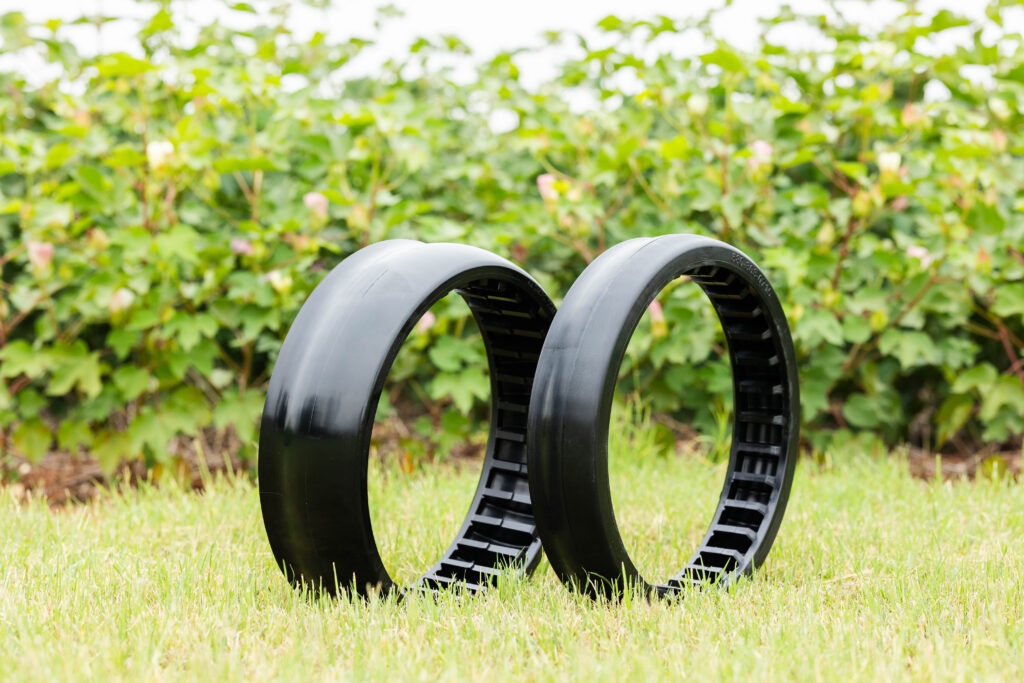
At 4AG Manufacturing, our gauge wheels are designed by farmers who understand no-till challenges because we farm too.
Built in Oklahoma, our gauge wheels are engineered for real-world field conditions.
Features include:
Available in 3” and 4.5” sizes
Patent-pending proprietary composition
No lip wear design
UV protection
Fits old and new style no-till planters
Backed by a 3-year manufacturer’s warranty
They’re built tough. They’re easy to install. And they’re made in the United States.
Built by farmers, for farmers.
Why Small Upgrades Lead to Big Results
It’s easy to focus on big equipment purchases. But sometimes yield gains come from refining the basics.
Seed depth consistency is foundational. Without it, every other input becomes less effective.
Gauge wheels may seem like a small part of your planter, but they directly influence stand uniformity. And stand uniformity influences yield.
If better yield is the goal, your planter setup matters.
If your planter setup matters, your gauge wheels matter.
Take the time to inspect them. Replace them when needed. Invest in durability that matches your no-till system.
Because better stands lead to better harvests.
No fluff. Just function.