Getting seed into the ground is only part of a successful planting pass. Once the seed is placed at the proper depth, the soil around it needs to be closed correctly so the seed has consistent access to moisture and the conditions it needs to germinate. That makes planter closing wheels one of the most important parts of the planting process.
In conventional fields, closing the seed trench can be relatively straightforward because the soil has already been worked. No till farming creates a different set of conditions. Your planter may be moving through heavy residue, firmer soil, changing moisture levels, and ground that has not been loosened by tillage. Your closing system has to perform through all of it.
When closing wheels do their job correctly, they help eliminate air pockets, improve seed-to-soil contact, and leave the soil in better condition for emergence. When they do not, even properly placed seeds can struggle.
At 4AG Manufacturing, we understand those challenges because our products started as solutions for problems we were experiencing on our own Oklahoma farm. Our no-till equipment is designed by farmers with the durability and practical performance needed for real-world planting conditions.
Why Seed-to-Soil Contact Matters for Emergence
A seed needs moisture, oxygen, and the right temperature to germinate, but proper planting depth is only part of the equation. Good seed-to-soil contact is also essential for creating consistent growing conditions.
When air pockets remain in the seed trench, moisture may not reach every seed evenly. This can lead to delayed germination and uneven emergence, giving some plants an early advantage over others.
Planter closing wheels complete the planting process by bringing soil back around the seed and properly closing the trench. This improves seed-to-soil contact and helps support stronger, more uniform emergence across the field.
What Planter Closing Wheels Actually Do
Planter closing wheels travel behind the seed placement system and close the furrow after the seed enters the trench. Their basic purpose sounds simple, but achieving the right closure across an entire field is anything but simple.
The wheels need to move enough soil to close the trench without creating unnecessary compaction over the seed. They also need to perform as soil texture, residue, and moisture conditions change throughout the field.
An effective closing system should help:
- Close the seed trench consistently
- Remove air pockets around the seed
- Establish good seed-to-soil contact
- Leave the surface in a condition that supports emergence
This is especially important with a no till planter because the soil has not been mechanically loosened before planting. The closing wheels are working directly with the field conditions that exist at planting time.
Why No Till Farming Demands More From Closing Wheels
No till farming offers important benefits, including reduced soil disturbance, residue retention, and opportunities to protect soil structure. But leaving the soil relatively undisturbed also changes what the planter encounters.
Crop residue remains on the surface. Soil can be firmer. Moisture levels can vary significantly across a field. Previous wheel tracks may create harder areas while other sections remain relatively loose.
The closing wheels have to respond to those conditions without creating a new problem.
A closing system that works adequately in loose, conventionally tilled soil may struggle to close a furrow in firm no-till ground. In wetter conditions, excessive pressure can compact or smear the soil. In dry conditions, an ineffective wheel may not move enough soil to completely close the trench.
That is why choosing closing wheels designed specifically for no-till conditions matters.
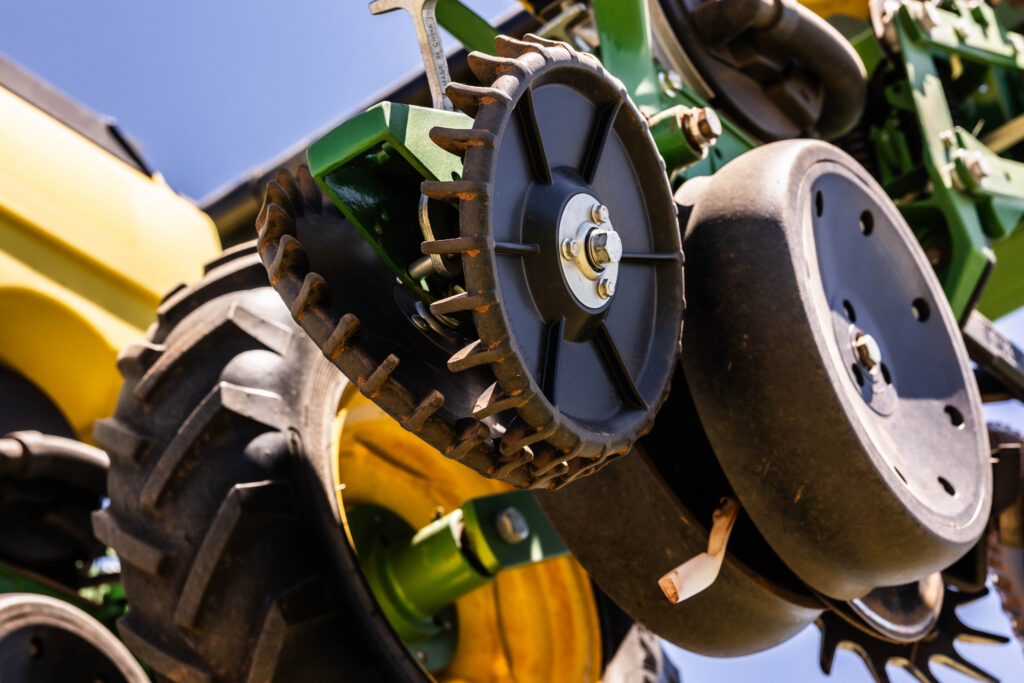
4AG’s planter closing wheels were designed by farmers for no-till planting. Each wheel features 24 tillers, and the design tills approximately the top quarter-inch of soil, leaving a softer surface while closing the trench. The wheels also include a bolt kit with spacers that allows for multiple adjustments to accommodate different planting conditions.
The Connection Between Closing Wheels and Even Emergence
When you walk a field after emergence, you want to see plants coming up consistently across the row. Planter closing wheels help create the seed-to-soil contact needed for more uniform germination and emergence.
Proper trench closure helps:
- Reduce air pockets around the seed
- Maintain more consistent access to soil moisture
- Support even germination across the row
- Improve overall stand establishment
Even when seeds are planted at the same depth, poor soil contact can delay germination. Across an entire field, those small differences can have a noticeable impact on crop emergence and early growth.
Avoiding Too Much Compaction
Closing the trench does not mean packing the soil as tightly as possible.
The goal is firm seed-to-soil contact below the surface while maintaining a soil structure above the seed that allows emergence. Too much pressure can create a dense layer over the row, particularly when planting into wet conditions.
As that soil dries, it can harden. Young plants then have to push through a more difficult surface to emerge.
4AG designed its closing wheels with tiller tines that work roughly the top quarter-inch of soil. This helps leave the ground surface loose while still closing the trench below. That design can help prevent surface baking in wet conditions and may eliminate the need for additional equipment such as a harrow or drag chain.
That balance is important. You want the trench closed, but you do not want to create another obstacle directly above the seed.
Your Gauge Wheels and Closing Wheels Work Together
Planting performance depends on how the entire row unit works together. Gauge wheels and closing wheels have different jobs, but both play an important role in creating consistent conditions for seed placement and emergence.
Gauge wheels help control seed depth as the planter moves across the field. Once the seed is positioned correctly, closing wheels finish the process by closing the trench and establishing proper seed-to-soil contact. If planting depth is inconsistent, closing wheels can’t fully correct it. Likewise, accurate depth won’t solve a seed trench that remains partially open.
That’s why both systems should be inspected before planting season. 4AG manufactures planter gauge wheels specifically for no-till planting, available in 3-inch and 4.5-inch sizes and designed to withstand sharp stubble, rocks, and demanding field conditions.
When gauge wheels maintain proper depth and closing wheels create consistent trench closure, the entire planting system works together to give each seed a better opportunity for strong, uniform emergence.
Signs Your Closing Wheels May Need Attention
Closing wheel problems are not always obvious from the tractor seat. Sometimes the first sign is an uneven stand weeks later, when the opportunity to correct the original problem has already passed.
That makes field checks during planting important.
Stop periodically and inspect the rows behind the planter. Dig seeds and examine the trench rather than relying only on what the soil surface looks like.
Watch for:
- Seed trenches that remain partially open
- Visible air pockets or loose soil around seeds
- Excessively packed soil directly over the row
- Closing wheels that are worn, damaged, misaligned, or not turning properly
Field conditions can change throughout a single day, especially as temperature and moisture change. A setup that performed well early in the morning may need another look later in the afternoon.
Adjusting Your No Till Planter for Field Conditions
There is no single closing-wheel adjustment that works perfectly for every field and every planting day.
That is why adjustability matters.
Soil type, moisture, residue, planting speed, crop, and field history can all influence how aggressively the trench needs to be closed. The best setup is the one that creates consistent closure under the conditions you are actually planting in—not the conditions you expected when you left the shop that morning.
4AG’s closing wheel assembly includes spacers that provide multiple adjustment options. That gives farmers flexibility when planting conditions change rather than forcing one fixed configuration across every acre.
The key is checking your results in the soil.
Get out of the cab. Dig behind several rows. Look at seed depth, soil contact, trench closure, and surface condition. A few minutes spent checking planter performance can reveal issues before they affect a significant number of acres.
Durability Matters During Planting Season
Planting windows do not care whether you have a broken wheel.
When field conditions are right, farmers need equipment that can keep moving. Repeatedly replacing worn planter components costs more than the price of the replacement part. It costs time during one of the most important windows of the year.
4AG manufactures its closing wheels from the same patent-pending proprietary composition used in its gauge wheels. The closing wheel is a solid tire with added UV protection and is designed to fit old and new-style no-till planters. Installation does not require a press, helping reduce downtime when wheels need to be installed or adjusted.
The closing wheels are designed for no-till farmers growing crops including cotton, soybeans, corn, milo, wheat, and sunflowers.
Durability may not directly germinate a seed, but dependable equipment helps maintain the consistent planter performance required to give those seeds the best possible start.
Better Emergence Starts With the Entire Planting System
There is rarely one planter component responsible for a perfect stand. Successful planting comes from a series of small jobs being performed correctly, row after row and acre after acre.
Seed meters need to deliver seed accurately. Openers need to create the trench. Gauge wheels need to maintain depth. The seed needs to land where intended. Finally, planter closing wheels need to close the trench and establish the soil environment that seed needs for germination.
Ignoring that final step can undermine everything that happened before it.
For farmers committed to no till farming, closing wheels become even more important because they must perform without the loose seedbed created by conventional tillage.
The objective is not simply to make the trench disappear. It is to create consistent seed-to-soil contact while leaving the surface in a condition that encourages strong, even emergence.
How to Choose Closing Wheels for a No Till Planter
When evaluating closing wheels, look beyond the initial price. Consider how the wheel is designed to interact with your soil, how easily it can be adjusted, what materials are used, and whether it is built for the conditions your farm encounters.
Ask how the wheel handles residue and firm ground. Consider whether you can adjust it when moisture conditions change. Look at installation requirements and expected durability.
Most importantly, evaluate performance in your own fields.
A quality closing wheel should become a dependable part of the planter rather than another component you spend planting season worrying about.
4AG Manufacturing began developing its own equipment after dealing with those same frustrations on its western Oklahoma farm. The company started creating no-till solutions in 2011 and continues to manufacture farming supplies focused on durability, efficiency, and practical field performance.
You can learn more about the company and its complete selection of no-till farming equipment before deciding which components make the most sense for your operation.
Give Every Seed a Better Start
You cannot control every variable that affects emergence. Weather will change. Soil conditions will vary. Residue will never distribute itself perfectly just because planting season has arrived.
But you can control how well your planter is prepared to handle those conditions.
Properly selected and adjusted planter closing wheels help create the seed-to-soil contact necessary for germination while leaving the soil surface ready for emerging plants. When combined with accurate depth control and regular field checks, the right closing system can help produce the uniform stands no-till farmers work toward every season.
At 4AG Manufacturing, our closing wheels were developed by farmers who needed equipment capable of standing up to real no-till conditions. They are built for durability, adjustability, and effective trench closure without unnecessary complication.
Ready to improve the performance of your no till planter? Explore 4AG’s planter closing wheels to learn more about specifications and features, or use the 4AG Dealer Locator to find knowledgeable farm equipment suppliers near you, or contact us for more information.
Because once the seed is in the ground, how you close the row can make all the difference in how the crop gets started.
Built by farmers, for farmers.
This article was generated with the assistance of artificial intelligence (AI). While reviewed for accuracy and clarity by 4Ag, it should be considered general information. We still recommend contacting the 4Ag team for personalized advice.