Crop cultivation has changed considerably as farmers have learned more about soil health, erosion, moisture conservation, residue management, and the long-term effects of disturbing the soil.
For generations, tillage farming was a standard part of preparing fields for planting. Plows, disks, cultivators, and other implements were used to loosen soil, manage weeds, incorporate crop residue, and create a seedbed for the next crop.
Those practices are still useful in many farming systems, but they are no longer the only option.
Reduced-till, conservation tillage, and no-till farming give producers different ways to prepare for planting while limiting soil disturbance and retaining more crop residue. Each system has advantages and challenges, and the right approach depends on factors such as soil type, crop rotation, moisture, residue, climate, equipment, and the goals of the individual operation.
Understanding these different approaches to crop cultivation can help farmers decide how much soil disturbance is actually necessary—and what equipment they need to establish a crop successfully.
What Is Crop Cultivation?
Crop cultivation is a broad term covering the practices used to grow and manage crops, from preparing the field and planting through crop management and harvest.
Soil preparation is one part of that process.
Traditionally, preparing a field often involved tillage: mechanically disturbing the soil with agricultural implements. Depending on the system, tillage can loosen or turn soil, incorporate crop residue, prepare a seedbed, manage weeds, or address certain field conditions.
The amount of disturbance can vary dramatically.
At one end of the spectrum is intensive conventional tillage, where several passes may significantly disturb the soil before planting. At the other is no-till farming, where seed is planted directly into relatively undisturbed soil and residue from previous crops remains on the surface.
Between those two approaches are several forms of reduced and conservation tillage.
That means modern crop cultivation isn’t necessarily about deciding whether tillage is “good” or “bad.” It’s about understanding what each practice does and determining which approach fits the field, crop, and operation.
What Is Tillage Farming?
Tillage farming uses mechanical equipment to manipulate soil before or during crop production.
Depending on the operation, farmers may use a plow, disk, field cultivator, chisel plow, harrow, or combinations of several implements.
The amount and depth of soil disturbance depend on the equipment and method being used.
Historically, intensive tillage provided farmers with a relatively clean, loose seedbed and an effective mechanical method of managing weeds and crop residue. However, disturbing more soil can also leave the surface more exposed to wind and water.
That’s one reason crop cultivation practices have evolved.
Instead of automatically making several tillage passes before every crop, many farmers now evaluate how much disturbance is necessary and whether some of those passes can be reduced or eliminated.
Understanding Different Tillage Methods
There isn’t one universal tillage system. Several approaches fall along a spectrum based largely on how much soil is disturbed and how much crop residue remains after field preparation.
Conventional or Intensive Tillage
Conventional tillage generally involves greater soil disturbance and may include multiple field operations before planting.
A farmer might use a moldboard or chisel plow followed by a disk, field cultivator, harrow, or finishing tool to prepare the seedbed.
One advantage is the ability to mechanically incorporate residue and create relatively uniform surface conditions before planting. Depending on the field, tillage can also be useful for managing certain weeds or addressing specific soil conditions.
The tradeoff is greater disturbance.
More passes require additional time, fuel, labor, and equipment use. Leaving less residue on the surface can also expose soil to erosion.
Reduced Tillage
Reduced tillage sits somewhere between intensive tillage farming and a no-till system.
Instead of completely eliminating tillage, farmers reduce the number or intensity of field operations.
This approach can allow producers to retain some of the benefits they want from tillage while leaving more residue and reducing the amount of soil disturbance.
The exact system can look different from farm to farm. The important distinction is that farmers are intentionally reducing the amount of mechanical disturbance compared with their conventional system.
Conservation Tillage
Conservation tillage refers to crop cultivation systems designed to retain protective crop residue at the soil surface.
The goal is particularly important where erosion is a concern.
Residue can help protect the ground from direct rainfall impact and slow water movement across the surface. It can also provide protection from wind.
Reduced-till and no-till practices can both fall within a broader conservation approach when enough residue remains to provide meaningful soil protection.
No-Till Farming
No-till farming takes soil disturbance reduction significantly further.
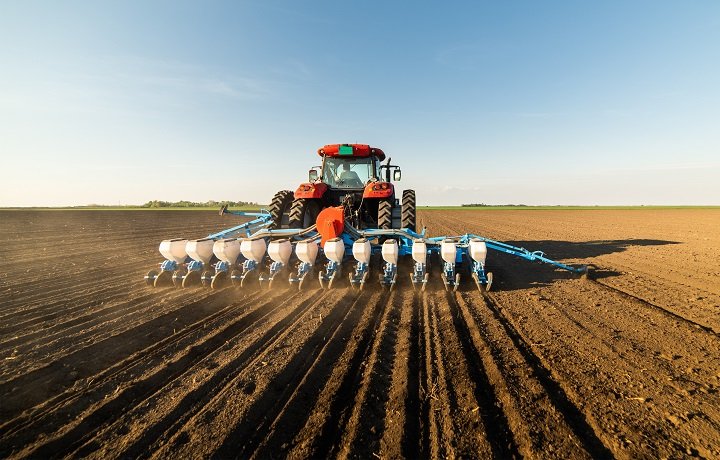
Rather than tilling the entire field before planting, the planter opens a relatively narrow seed trench, places the seed, and closes the trench again.
Residue from the previous crop remains largely on the surface.
This fundamentally changes the role of planting equipment.
With conventional tillage, several implements may be used to prepare the soil before the planter arrives. With no-till farming, the planter has to perform accurately in residue and relatively undisturbed soil.
That makes planter setup and individual row-unit components particularly important.
Why Are Farmers Reducing Tillage?
One of the biggest reasons is soil protection.
When bare soil is exposed to heavy rainfall or strong winds, particles can be moved away from the field. That erosion can gradually remove valuable topsoil and organic matter.
Leaving crop residue on the surface creates physical protection.
Residue can absorb some of the impact from rainfall, reduce wind exposure at the soil surface, and help slow runoff. Less aggressive soil disturbance can also allow more of the existing soil structure to remain intact.
Moisture is another consideration.
Crop residue shades the soil surface and can help reduce direct evaporation under certain conditions. In areas where moisture is frequently a limiting factor, retaining more water in the soil can be valuable.
These benefits help explain why conservation practices and no-till farming have become increasingly important parts of crop cultivation.
No-Till Farming Doesn’t Mean “Do Nothing”
The name can sometimes create the wrong impression.
No-till farming doesn’t mean a farmer stops managing the field. It means soil disturbance is concentrated primarily where it is necessary for planting rather than across the entire field.
The planter still needs to:
- Move through existing crop residue.
- Maintain appropriate seed depth.
- Place seed consistently.
- Establish good seed-to-soil contact.
- Properly close the seed trench.
Those jobs can become more challenging when you’re planting into residue and firmer, undisturbed soil.
That’s why changing the tillage system without considering planter performance can create problems.
Successful no-till crop cultivation requires equipment capable of handling the conditions created by the system.
Planter Performance Becomes Critical in No-Till Farming
Consider what happens during a planting pass.
The row unit needs to follow the field surface while maintaining the selected planting depth. The opener creates the seed trench, seed is placed, and the closing system needs to bring soil back around that seed.
Each part affects the next.
If depth varies significantly, seeds may experience different moisture and temperature conditions. If the trench isn’t properly closed, air pockets or exposed seed can interfere with the environment needed for germination.
The goal is consistency.
This is where seemingly small planter components can have an important job.
Gauge Wheels Help Control Planting Depth
Gauge wheels run alongside the row unit and help control the relationship between the opener and soil surface.
In a no-till system, those wheels may encounter sharp stalks, heavy residue, rocks, uneven surfaces, and other demanding conditions.
Durability therefore matters.
4AG planter gauge wheels are available in 3-inch and 4.5-inch sizes and are designed to withstand sharp stubble, rocks, UV exposure, and demanding field conditions. They’re designed to eliminate lip wear and are backed by a three-year manufacturer’s warranty.
A gauge wheel is only one component of a much larger planter, but maintaining consistent performance at each row contributes to the overall quality of the planting pass.
Closing Wheels Finish the Seed Trench
After the seed has been placed, the trench still needs to be closed.
Closing wheels return soil around the seed to establish the seed-to-soil contact necessary for germination and early development.
This can be particularly important in no-till farming because undisturbed soil can behave differently than a loose conventional seedbed.
The 4AG planter closing wheel features 24 tillers per wheel and is designed to work with old and new style no-till planters. The tillers work the surface around the trench while the closing system helps establish seed-to-soil contact.
The objective isn’t to till the entire field.
Instead, the planter manages the relatively small area where the seed needs to become established while leaving most of the surrounding soil and residue undisturbed.
That illustrates one of the biggest differences between intensive tillage farming and no-till crop cultivation.
Is No-Till Farming Always the Best Choice?
There isn’t one crop cultivation method that’s automatically best for every field.
No-till farming offers meaningful soil-conservation advantages, but farmers still need to consider their particular conditions.
Soil type, drainage, compaction, crop rotation, residue levels, weed management, climate, available equipment, and management experience can all influence how a system performs.
Some operations may transition gradually by reducing tillage rather than eliminating it immediately. Others may use different systems in different fields.
The important part is understanding why you’re making each pass.
If a tillage operation solves a specific problem, it may have a clear purpose. If you’re making the same pass simply because it has always been part of the routine, it may be worth evaluating whether it’s still necessary.
Modern crop cultivation gives farmers more choices than an all-or-nothing approach.
Consider the Cost of Every Field Pass
Soil health isn’t the only reason to evaluate tillage.
Every trip across the field has a cost.
There’s fuel, labor, equipment wear, maintenance, and time. During a narrow planting window, time can become especially valuable.
Reducing unnecessary tillage passes may allow farmers to cover acres more efficiently while reducing fuel and equipment use.
That doesn’t mean fewer passes automatically equal greater profitability. A pass that addresses a real agronomic problem may be well worth the expense.
Instead, think of each operation as an investment.
What does this pass accomplish? Is there another way to achieve the same result? Does it support the goals of the crop cultivation system?
Those questions can help farmers build a system around what their fields actually need.
Soil Health Is a Long-Term Investment
A single season rarely tells the entire story.
Soil changes over time, and the effects of crop cultivation practices can accumulate across many growing seasons.
Protecting topsoil, retaining residue, managing traffic, maintaining fertility, rotating crops, using cover crops where appropriate, and reducing unnecessary disturbance can all contribute to a broader soil-management strategy.
No-till farming can be one piece of that strategy.
The goal isn’t simply to disturb less soil because less is always better. The goal is to create a production system capable of establishing healthy crops while protecting the resource those crops depend on.
For many farmers, that means becoming more intentional about when, where, and why the soil is disturbed.
Build a Crop Cultivation System Around Your Farm
There is no universal recipe for farming.
What works in western Oklahoma may not be identical to what works in Iowa, Kansas, Texas, or another part of the country. Even two neighboring fields can respond differently because of variations in soil, drainage, slope, residue, and previous management.
The best crop cultivation strategy is one built around the conditions you’re actually farming.
For some operations, that may include conventional tillage. Others may move toward reduced or conservation tillage. And many farmers are finding ways to make no-till farming work as part of their long-term soil-management strategy.
Whatever approach you choose, reliable equipment matters.
At 4AG Manufacturing, our products come from firsthand experience with the problems farmers encounter in the field. Our farming tools include planter gauge wheels, closing wheels, the Inter Seeder, and other practical equipment designed around real agricultural work.
Because changing how you manage the soil doesn’t change the ultimate goal: establish the crop consistently, protect the resources your farm depends on, and keep the operation productive for the seasons ahead.