Healthy soil is one of the most valuable resources on any farm. It supports crop growth, stores moisture, provides nutrients, and creates the foundation farmers depend on season after season. Protecting that resource is one reason more growers have incorporated no-till farming into their operations.
Instead of aggressively disturbing the soil before every planting, no-till farming leaves much of the previous crop residue and soil structure in place. That change in approach can help reduce erosion, conserve moisture, and support healthier soil over time. It can also create new challenges during planting, particularly when residue, moisture, and varying soil conditions make it harder to establish a consistent seed trench.
Successful no-till planting is therefore about more than simply eliminating tillage. Farmers still need the right management practices and farming implements to place seed accurately, close the trench properly, and give each seed a strong environment for germination.
At 4AG Manufacturing, those challenges are familiar because our products are designed by farmers with firsthand experience in no-till fields. Understanding what is happening beneath the planter can help farmers make decisions that protect the soil today while supporting productivity for years to come.
Why Soil Protection Matters in No-Till Farming
Every planting season places demands on the soil. Equipment moves across the field, weather changes soil conditions, crops remove nutrients, and wind and water can move exposed topsoil away from where it belongs. Over time, those pressures can influence soil structure and the field’s ability to support productive crops.
Conventional tillage can create a clean seedbed, but disturbing and exposing soil also leaves it more vulnerable to environmental forces. No-till farming takes a different approach by minimizing that disturbance and keeping more crop residue on the surface.
This can provide several important benefits:
- Reduced exposure of topsoil to wind and water erosion
- More crop residue available to protect the soil surface
- Improved moisture conservation under appropriate conditions
- Less mechanical disturbance of existing soil structure
- Fewer tillage passes across the field
These advantages help explain why no-till farming is often part of conversations surrounding environmentally friendly farming. Reducing unnecessary soil disturbance can protect the resources already present in the field while allowing farmers to continue producing crops efficiently.
However, protecting soil does not mean ignoring what happens during planting. In fact, the planter becomes even more important when farmers are working through residue and undisturbed ground.
Reducing Soil Erosion by Leaving the Ground Covered
One of the clearest reasons for reducing tillage is erosion control. Bare, disturbed soil has less protection when strong winds move across a field or heavy rainfall arrives. Soil particles can be carried away, potentially taking valuable nutrients and organic matter with them.
Crop residue provides a layer between the soil and those forces. Instead of rain striking exposed ground directly, residue can help reduce the immediate impact at the surface. Likewise, leaving material in the field can help protect soil from wind.
This matters because topsoil cannot simply be replaced overnight. Building productive soil is a long-term process, and preventing unnecessary soil loss is generally more practical than trying to restore it later.
For farmers interested in environmentally friendly farming, erosion prevention is not just an environmental consideration. Protecting soil is also protecting a productive farm resource. Keeping more of that soil in place helps preserve the foundation future crops will depend on.
No-Till Planting Can Help Preserve Soil Structure
Repeatedly disturbing soil changes its physical structure. No-till planting minimizes some of that disruption by allowing more of the existing soil profile to remain intact between growing seasons.
Healthy soil is not simply loose dirt. It contains pores, channels, organic material, roots, microorganisms, and aggregates that collectively influence how water and air move through the ground. Reducing unnecessary disturbance can allow some of these natural characteristics to remain in place.
That does not mean every no-till field automatically develops perfect soil. Soil type, crop rotation, weather, traffic, compaction, residue management, and other factors still matter. No-till farming is one component of a larger management strategy.
The difference is that farmers are working with the existing soil structure rather than mechanically rebuilding the seedbed before every crop. That makes precision at planting particularly important.
Moisture Management Is Another No-Till Farming Advantage
Moisture can be one of the biggest variables farmers face. Too little moisture creates obvious problems, while excessive moisture can make fieldwork and planting equally difficult.
Surface residue can help reduce direct evaporation by shielding the soil from sun and wind. When conditions are dry, conserving available moisture can be particularly valuable.
But moisture also demonstrates why no-till farming requires careful planter setup. Undisturbed soils can behave differently from a conventional seedbed, and conditions can vary considerably across a single field.
The goal is not simply to retain moisture. Farmers need to place each seed into an environment where it can access appropriate moisture while maintaining the soil conditions necessary for germination and root development.
That brings us to one of the most important parts of no-till planting: creating consistent seed-to-soil contact.
Why Seed-to-Soil Contact Matters in No-Till Planting
A farmer can protect soil throughout the year and still lose some of those benefits if the planter does not establish the seed properly. Once a seed enters the trench, the surrounding soil becomes its immediate growing environment.
After seed placement, the trench needs to be properly closed so soil can make contact around the seed. Air gaps, exposed seeds, excessive compaction, or an incompletely closed trench can interfere with the conditions needed for consistent germination.
This is where closing wheels become important farming implements.
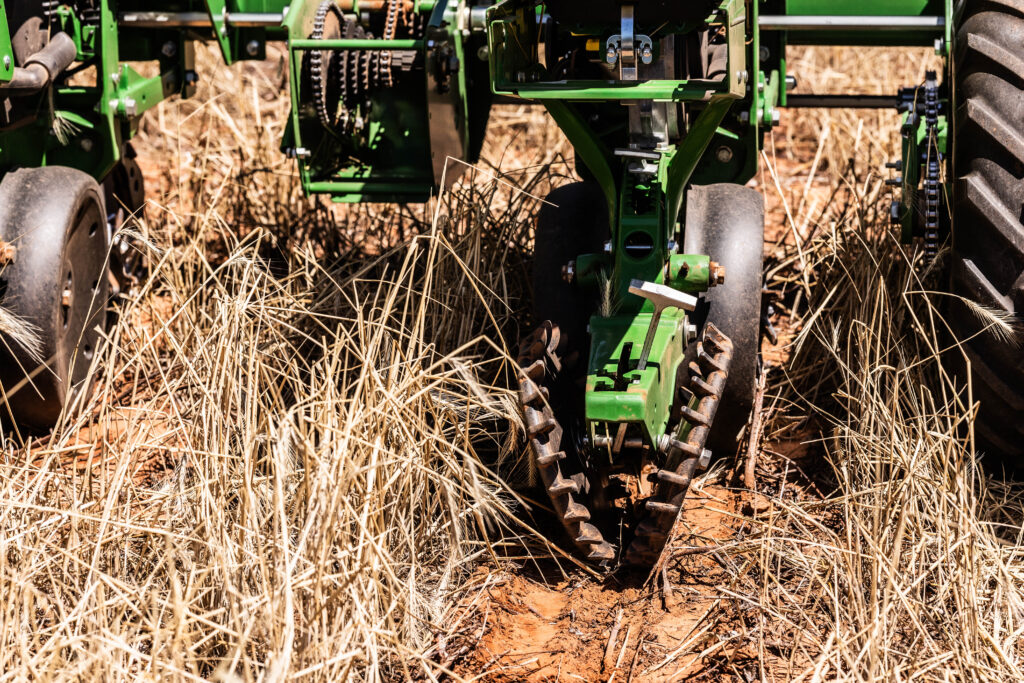
According to 4AG, a closing wheel presses soil back over the seed after placement to establish seed-to-soil contact that supports germination and early root development. Properly adjusted closing wheels should leave the seed trench completely closed without visible air gaps or exposed seeds.
For farmers using a no-till planter, that final step can make an important difference in how successfully the planter handles varying field conditions.
The Role of Closing Wheels in No-Till Farming
The closing system finishes the job the planter began. The opener creates the trench, the seed is placed at the selected depth, and the closing wheels bring soil back around it.
In no-till conditions, that process can become more challenging because the planter may be moving through crop residue and firmer or more variable soil. The closing wheels need to close the trench effectively without creating excessive compaction.
4AG’s planter closing wheels were developed specifically for these conditions. The design uses 24 tillers per wheel and is intended to till approximately the top quarter-inch of soil. According to 4AG, this leaves a loose surface, helps close the point where the sides of the seed trench meet, and can reduce the need for additional equipment such as a harrow or drag chain.
That illustrates an important principle of no-till planting: farmers may be reducing overall soil disturbance, but the small amount of soil immediately surrounding the seed still needs to be managed correctly.
Avoiding Too Much or Too Little Downforce
Closing wheels also need to be adjusted for actual field conditions. More pressure is not automatically better.
Too much downforce can contribute to compaction, while too little can leave the seed trench partially open. 4AG recommends adjusting downforce according to soil condition and moisture and testing those settings in the field.
Farmers should watch for several indicators behind the planter:
- A completely closed seed trench
- No exposed seed or obvious air gaps
- Adequate soil coverage without excessive compaction
- Consistent performance as moisture or soil conditions change
The right adjustment can change throughout the planting season. A setting that performs well in one field or moisture level may not be ideal somewhere else.
How Better Soil Conditions Can Support Crop Productivity
Protecting soil and improving crop productivity are not separate goals. The long-term productivity of a farm depends heavily on the condition of the resource crops grow in.
No-till farming can help preserve soil by reducing disturbance and erosion while keeping residue on the surface. Over time, thoughtful soil management can create a stronger foundation for crop production.
Then, during planting, the goal shifts from protecting the entire field to creating the best possible environment around each individual seed.
Consistent seed placement, appropriate depth, complete trench closure, and good seed-to-soil contact can support more consistent germination and emergence. The 4AG closing wheel was specifically designed to improve seed-to-soil contact and increase emergence while leaving a soft-tilled surface behind the planter.
No farming implement can guarantee yield. Weather, fertility, pest pressure, crop genetics, planting conditions, and countless other variables affect the final result. But eliminating avoidable inconsistencies during planting gives the crop a better opportunity to establish well.
Choosing Farming Implements for No-Till Conditions
Moving toward environmentally friendly farming practices does not mean farmers need less capable equipment. In many cases, reducing tillage makes planter performance even more important.
The right farming implements need to handle residue, variable soil conditions, and the wear associated with operating in no-till fields. They also need to work together as a system.
Gauge wheels, for example, help maintain planting depth, while closing wheels handle the soil after seed placement. 4AG notes that these components perform different but essential functions during planting.
Farmers should consider soil conditions, crop residue, planter compatibility, durability, adjustment options, and the type of performance they are seeing behind the planter when evaluating equipment.
4AG’s closing wheels are designed to fit old and new style no-till planters and feature a solid tire made from the company’s proprietary composition with added UV protection. They were developed after 4AG’s own experience farming no-till cotton in western Oklahoma and dealing with components that required frequent replacement.
Environmentally Friendly Farming Still Has to Be Practical
Sustainability on a farm has to work in the real world. A practice that protects resources but prevents farmers from operating productively is difficult to maintain. Likewise, chasing short-term productivity while degrading the resources the farm depends on can create long-term problems.
No-till farming offers an opportunity to bring those goals closer together.
Reducing tillage can mean fewer passes dedicated specifically to soil preparation, less disturbance, more residue left on the surface, and greater protection against erosion. At the same time, farmers can use carefully selected farming implements to manage the seed zone precisely rather than disturbing the entire field.
That balance is part of what makes no-till planting appealing as a long-term approach. The objective is not to stop managing the soil. It is to manage it more intentionally.
Long-Term Productivity Starts With Protecting the Soil
Farmers make decisions every season based on conditions they cannot completely control. Rainfall, temperature, input costs, and markets will always introduce uncertainty. Soil, however, is one resource farmers can actively work to protect.
No-till farming can help keep more soil in place, preserve surface residue, reduce unnecessary disturbance, and support moisture management. Combined with thoughtful crop management and properly configured farming implements, those practices can create a stronger foundation for long-term production.
The planting pass remains one of the most important pieces of that strategy. Accurate seed depth and complete trench closure help ensure that reducing tillage does not mean sacrificing the environment immediately surrounding the seed.
Build a Better No-Till Planting System With 4AG
At 4AG Manufacturing, our equipment is designed by farmers who understand what no-till farming asks of both the land and the planter. Our closing wheels were created to withstand demanding field conditions while helping improve seed-to-soil contact and properly close the seed trench.
If you’re looking for farming implements designed specifically for no-till planting, explore the 4AG planter closing wheels or use the 4AG dealer locator to find a dealer near you.